

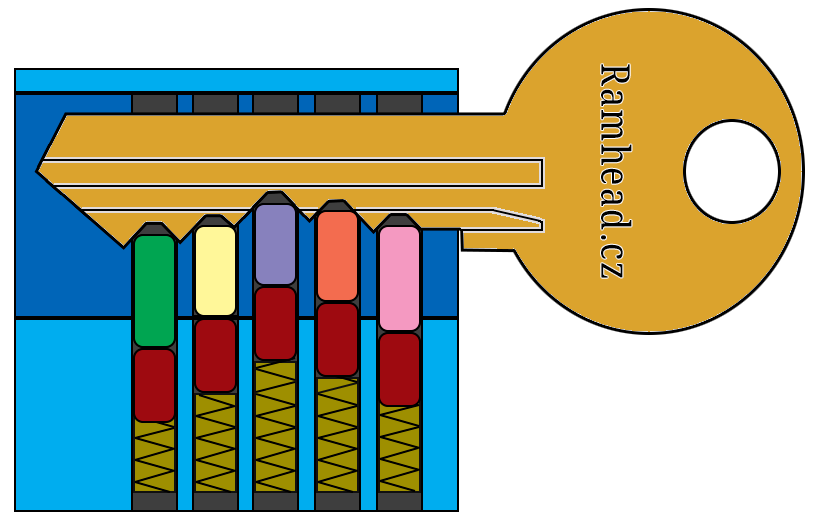
The mechanism of the lock consists of an inner cylinder (dark blue) which rotates in an outer cylinder (light blue) with the help of a key. Locking and the inability to turn the lock is ensured by pins that interfere into both layers.
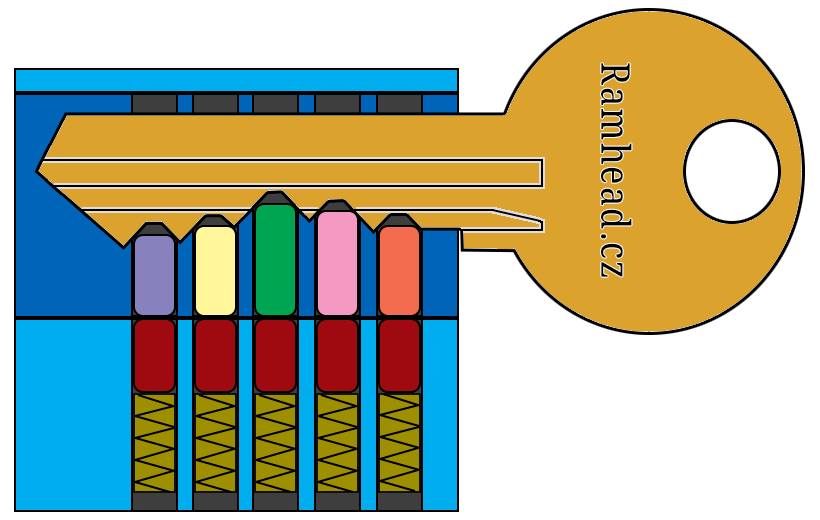
The pins are pushed against the key by springs. Only the key matching the lock pattern will push the pins back, in such a way that the bottom pins (dark red) do not interfere the top layer and the top pins (colored) do not interfere the bottom layer.
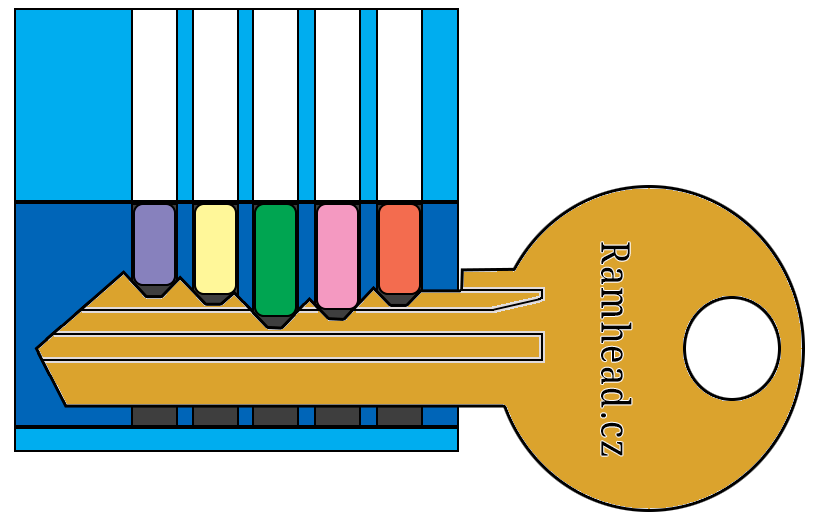
The presence of springs would greatly complicate the production of the puzzle. I replaced the function of the springs (their force) with the force of gravity. This was done by simply turning the entire lock mechanism up side down.
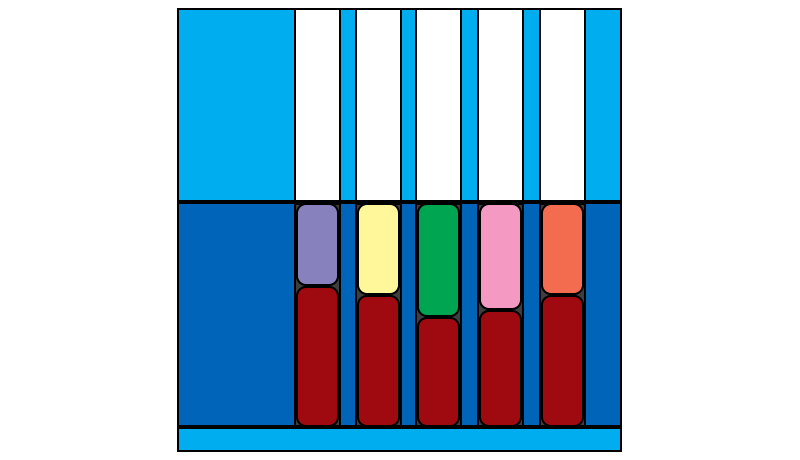
The next step leading to the overall simplification of the mechanism was the removal of the key itself. The different height key's teeth have been replaced with different height/coding pins (dark red).
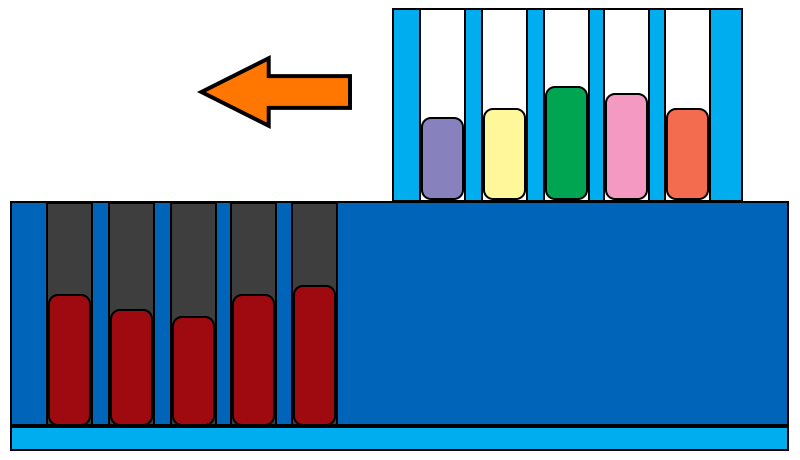
The mechanism for inserting and turning the key also had to be simplified overall. That's why I replaced the inner cylinder and outer cylinder with two blocks (cuboids) that are not mechanically connected. Rotational motion has been replaced by planar motion.
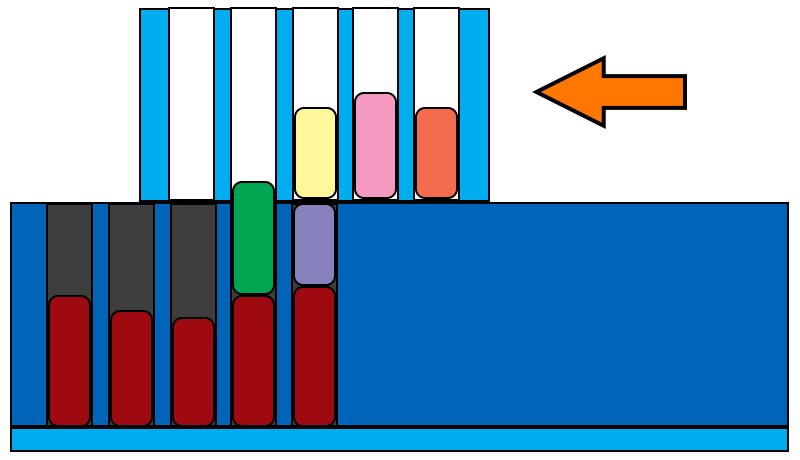
In the picture above, the green pin has been placed in the wrong position. The sum of the heights of the dark red pin and the green pin exceeds the height of the dark blue cuboid and blocks the light blue cuboid in motion.
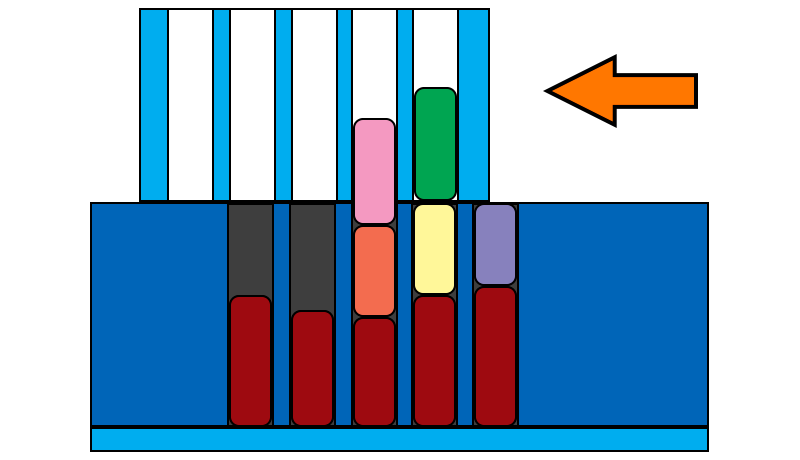
Improper placement of the orange pin results in the light blue cuboid being blocked during the next movement. The insufficient height of the orange pin in the chamber did not prevent further filling of the chamber with the pink pin. The puzzle mechanism was created, but too many pins were needed even for a simple puzzle.
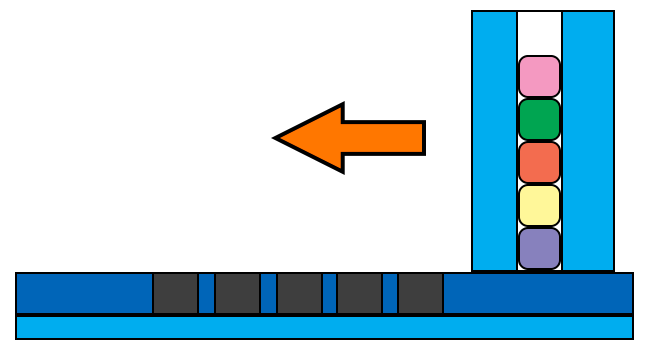
It was not enough to just put the pins on top of each other in the magazine (light blue). The magazine was too high. I completely removed the demarcation pins (dark red) from the mechanism. I also limited the different heights of the colored pins to one height, the lowest one. At this moment, I needed to distinguish the pins from each other in some way other than height, so I started to distinguish them by color. In the previous images, the pins should have same color, but for presentation reasons, I started to color them differently from the beginning of the document.
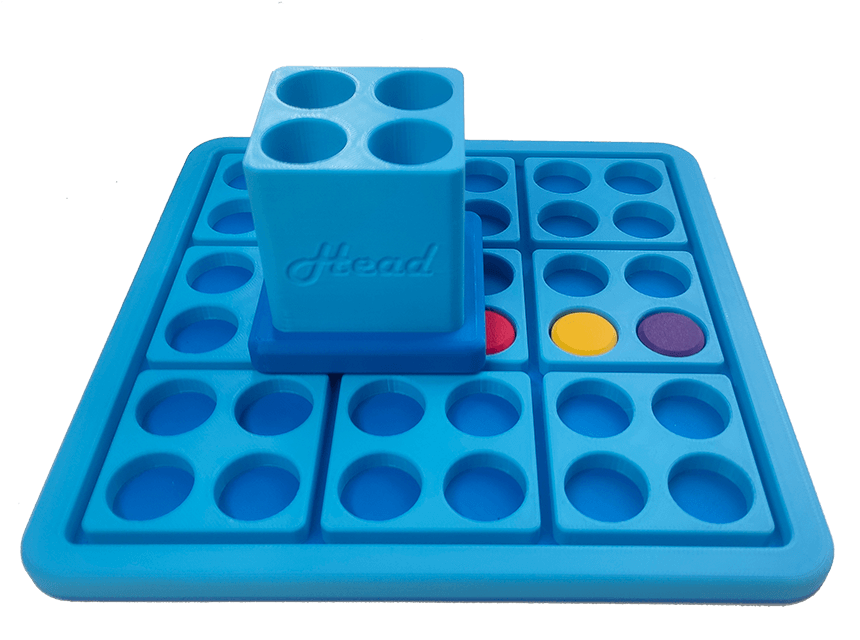
To further increase the difficulty of the puzzle, I needed to increase the number of chambers, as well as the number of pins. I also needed to reduced the height of the magazine. Therefore I increased the number of chambers in the magazine too; from one to four and modified the game board to allow movement in two axes.